
Estimate Generator Size
Work out what size standby generator your home needs in kilowatts. Choose essential circuits or whole-home coverage, add central air conditioning using the locked-rotor amps from its nameplate, and see the recommended kW rating with headroom — plus what that means for transfer switches and fuel.
- Free to use
- No sign-up
- Runs in your browser
Standby generator kW estimate
Standby Generator Sizing Workbook
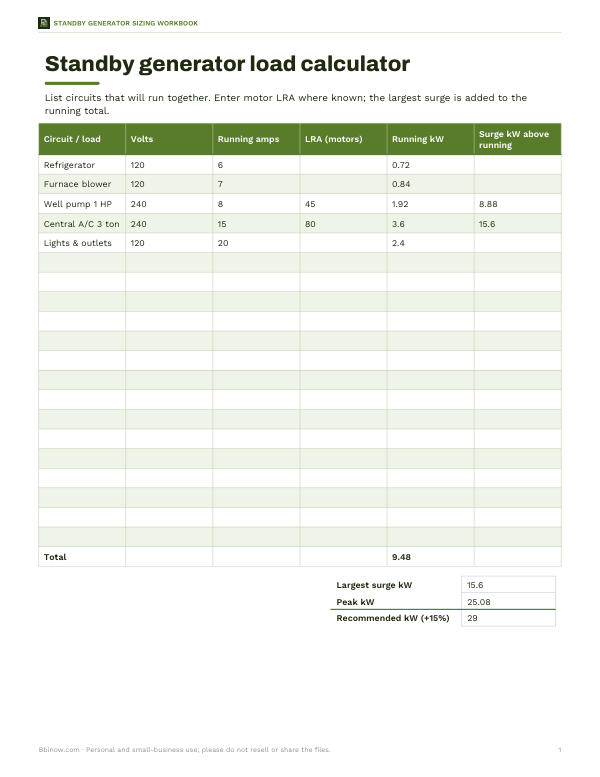
Excel circuit-by-circuit load calculator with motor surge, essential-circuit planner, installer quote comparison sheet and maintenance log.
- Circuit load calculator (XLSX)
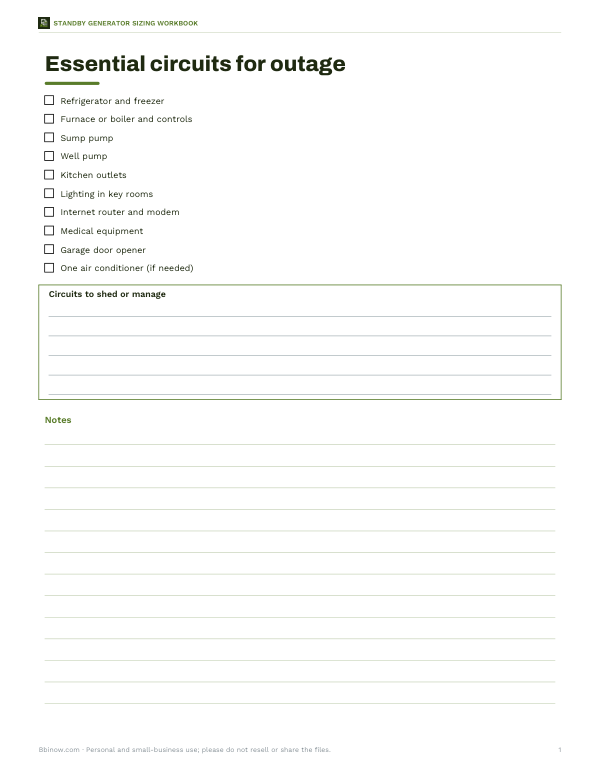
- Essential circuit planner (PDF, DOCX)
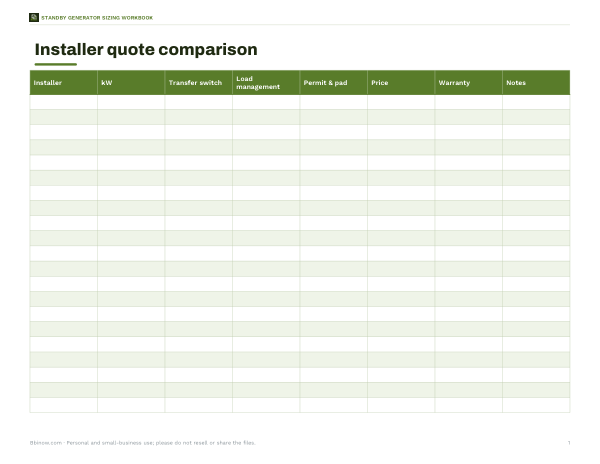
- Quote comparison (PDF, DOCX, XLSX)
- Maintenance log (PDF, DOCX, XLSX)
Formats: XLSX, PDF, DOCX. Instant download after payment (link valid 72 hours, up to 5 downloads). AI-assisted: the templates were drafted with AI help and reviewed and laid out before publishing.
$5.00 USD, one-time 4 files · about $1.25 each
- Instant download
- 7-day refund
- Secure checkout by Stripe
7-day money-back guarantee. Full refund within 7 days of purchase, even after you download.
Free sample: Essential Circuit Planner (PDF, 53 KB)
Full refund within 7 days — see the refund policy and license.
Free printables
Single sheets you can print right now, no sign-up. The full pack adds every sheet in one download plus the editable files.
 Printable Generator Maintenance Log
How standby generators are sized
A home standby generator is permanently installed outside, runs on natural gas or propane, and starts automatically through a transfer switch when the power fails. It is rated in kilowatts (kW). To size one, add the loads that will run at the same time, then make sure the generator can also handle the brief surge when the biggest motor — usually the central air conditioner compressor or a well pump — starts while everything else is running. Installers also add some headroom so the generator is not running at its limit.
Essential circuits or whole home?
| Approach | What it covers | Typical size |
|---|---|---|
| Essential circuits | Fridge, freezer, lights, outlets, furnace blower, sump or well pump, internet, maybe one A/C | About 8–14 kW |
| Managed whole home | All circuits through a service-rated transfer switch with load-shedding modules that pause big loads | About 14–24 kW |
| Full whole home | Everything at once, including electric heat, range, water heater and dryer | 24 kW and up |
Load management lets a smaller generator cover a whole home by switching off big loads such as the water heater or a second air conditioner while another large load runs. Many modern transfer switches support this.
Why A/C starting current matters
An air conditioner compressor draws several times its running current for a fraction of a second when it starts. The nameplate on the outdoor unit lists RLA (rated load amps) and LRA (locked-rotor amps). Multiplying LRA by 240 volts gives the starting kVA. A 3-ton unit with an LRA of 80 amps needs about 19 kVA for a moment — more than its 3–4 kW running draw. Generators are designed to handle short surges, but the surge must fit within the generator’s capability with the other loads running. A soft-start kit fitted to the compressor can cut the starting current substantially and often allows a smaller generator.
How the estimator works
- Adds your base loads — lighting, outlets, refrigerator, electronics.
- Adds heating, well pump and, for whole-home coverage, cooking, water heating and drying at typical ratings.
- Converts the A/C running amps to kW at 240 V.
- Calculates the extra starting surge of the A/C (from LRA) and of the well pump, and uses the larger one.
- Adds about 15% headroom and rounds up to a common standby size.
The numbers are typical figures to get you in the right size range before speaking to installers. They are not a substitute for an electrical load calculation.
Worked example
A house with a gas furnace (0.8 kW blower), 3 kW of base loads, a 1 HP well pump (about 1.1 kW running) and a 3-ton central A/C with 15 RLA and 80 LRA covers essential circuits. Running load is about 8.5 kW (3 + 0.8 + 1.1 + 3.6). The A/C starting surge adds roughly 15.6 kW above its running draw, giving a peak of about 24 kW and a recommendation near 28 kW, which rounds to a 30 kW class generator. Adding a soft-start kit cuts the surge to about 4 kW, bringing the recommendation down to about 15 kW — a 16 kW unit. This is why soft-start kits are popular.
Portable or standby?
| Portable generator | Home standby | |
|---|---|---|
| Power | About 3–12 kW | About 10–26 kW for homes; larger available |
| Fuel | Petrol; some dual-fuel with propane | Natural gas or propane from a fixed supply |
| Start | Manual; you connect cords or an inlet | Automatic through a transfer switch |
| Installation | Needs an interlock or transfer switch for house circuits | Professional installation, permit and pad |
| Cost | Lower | Higher |
For sizing a portable generator by individual appliance watts, see a portable generator wattage worksheet; standby sizing works best from circuits and nameplates.
Fuel and runtime
Standby generators burn more fuel at higher loads. Natural gas supply is continuous but the gas meter and pipe must be large enough for the generator plus other gas appliances. Propane runtime depends on tank size; manufacturers publish fuel consumption at half and full load for each model, so use those figures to plan tank size for multi-day outages.
Installation and safety
- Installation normally requires a permit and a licensed electrician; gas connection may require a licensed gas fitter.
- The transfer switch prevents backfeeding the utility lines, which protects line workers.
- Generators must be placed at the distance from windows, doors and vents specified by the manufacturer and local codes to avoid carbon monoxide entering the home.
- Install CO alarms inside the home.
- Schedule maintenance: oil, filters, battery and the weekly exercise cycle.
Getting quotes
Before asking for quotes, list the circuits you consider essential, photograph the A/C and well pump nameplates, and note your gas meter size or propane tank capacity. Ask each installer for their load calculation, the transfer switch type (essential-circuit or service-rated), whether load management is included, and what permits and pad work are covered. Compare quotes on the same coverage so the kW figures are comparable.
Frequently asked questions
What size generator do I need for a 2,000 sq ft house?
Floor area alone is a poor guide; loads matter. Many homes of that size fall in the 14–22 kW range for managed whole-home coverage, less for essentials.
Can a 22 kW generator run a whole house?
Often yes with load management, but electric heat, several A/C units and electric appliances running together may exceed it.
What is LRA on an air conditioner?
Locked-rotor amps — the starting current of the compressor, printed on the nameplate.
Does a soft start help generator sizing?
Yes, it reduces the compressor’s starting current, often allowing a smaller generator.
Do I need an electrician?
Yes. Transfer switch and standby generator installation requires a licensed professional and usually a permit.
Is this calculation stored?
No, it runs in your browser only.